

DOSE MODIFICATIONS AND TREATMENT TO HELP MANAGE ADVERSE REACTIONS FOR THE NALIRIFOX REGIMEN
Recommended dose modifications for ONIVYDE in combination with oxaliplatin, fluorouracil, and leucovorin1
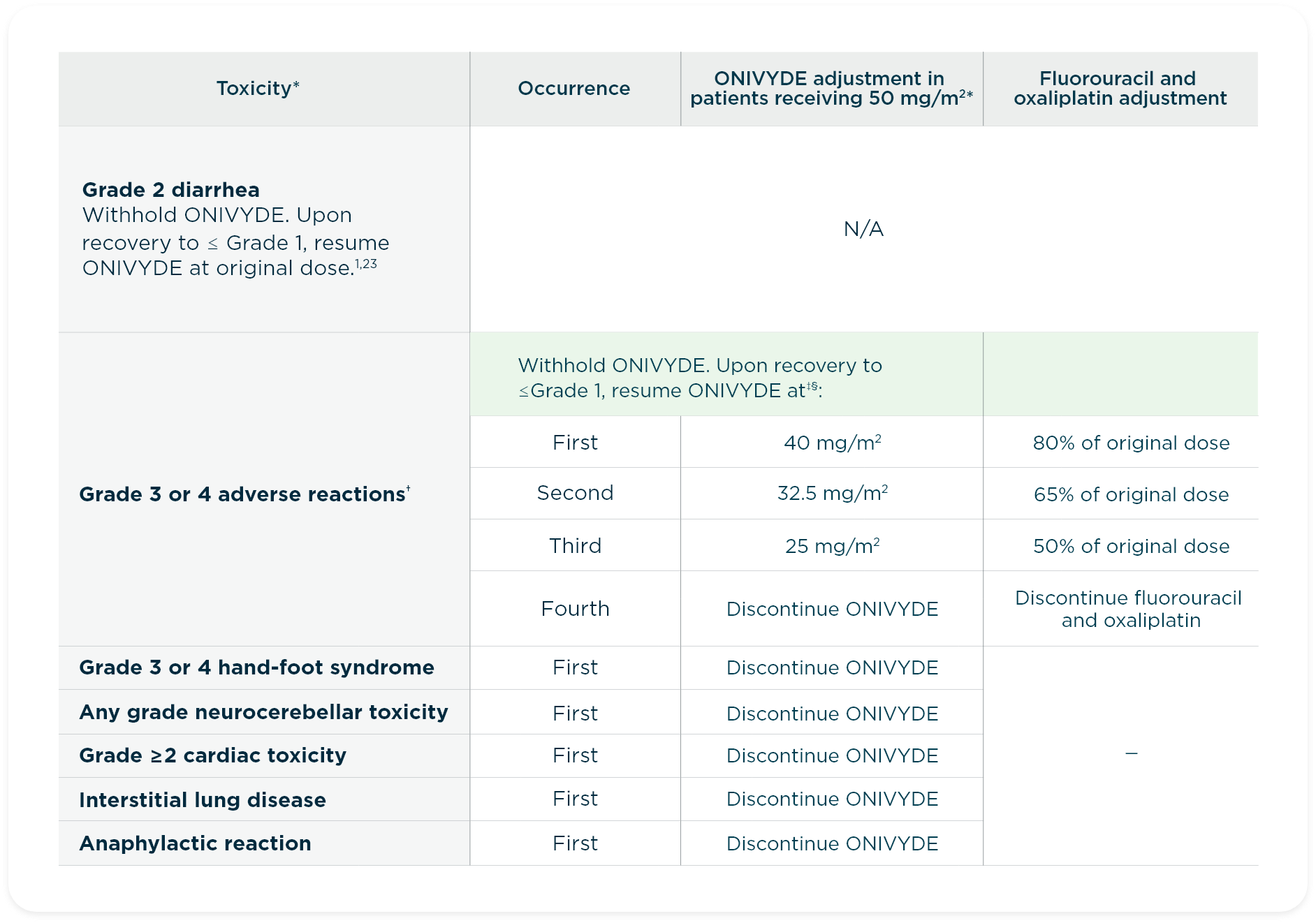
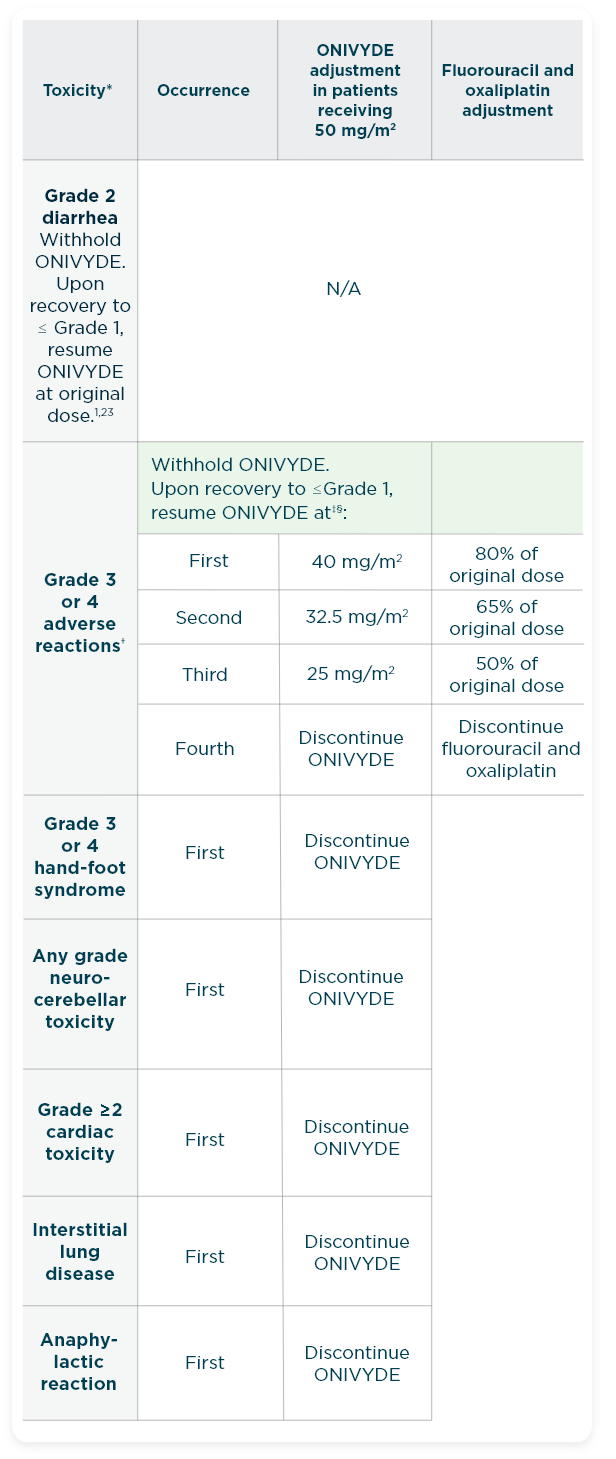
Oxaliplatin may be discontinued if not well tolerated and treatment with ONIVYDE + FU/LV can continue. Maintain original dose level of leucovorin for first, second, and third occurrence of toxicity. Refer to the full Prescribing Information of fluorouracil and oxaliplatin1
* NCI CTCAE v5.0.
† No dosage modification is necessary for asthenia, alopecia, and Grade 3 anorexia.
‡ Do not resume until the absolute neutrophil count is ≥2000/mm3 (2x10⁹/L) and the platelet count is ≥100,000/mm3 (100x109/L).
§ For Grade ≥3 nausea and vomiting, reduce dose only if occurs despite optimal antiemetic therapy.
Recommended dose modifications for severe neutropenia and severe diarrhea1
| Neutropenia | Diarrhea | |
|---|---|---|
| Withhold ONIVYDE | Monitor complete blood cell counts on Days 1 and 8 of every cycle and more frequently if clinically indicated. Withhold ONIVYDE if the absolute neutrophil count (ANC) is below 1500/mm3 or if neutropenic fever occurs. |
To reduce the risk of severe diarrhea, patients should stop lactose-containing products, eat a low-fat diet, and maintain hydration during treatment with ONIVYDE. Withhold ONIVYDE for Grade 2-4 diarrhea. Administer intravenous or subcutaneous atropine 0.25 mg to 1 mg (unless clinically contraindicated) for early-onset diarrhea of any severity. Initiate loperamide for late-onset diarrhea any severity. Local institutional guidelines should be followed for the treatment of diarrhea that does not improve within 48 hours and may include the addition of diphenoxylate hydrochloride plus atropine sulfate or octreotide. |
| Resume ONIVYDE | Resume ONIVYDE when the ANC is 1500/mm3 or above. | For Grade 2 diarrhea, upon recovery to ≤Grade 1, resume ONIVYDE at original dose.23 For Grade 3-4 diarrhea, resume ONIVYDE at a reduced dose following recovery to Grade 1 diarrhea. |
| Reduce ONIVYDE | For Grade 3-4 neutropenia or neutropenic fever, reduce ONIVYDE following recovery in subsequent cycles. | For Grade 3-4 diarrhea, reduce ONIVYDE following recovery to Grade 1 diarrhea. |
| Withhold ONIVYDE | |
|---|---|
| Neutropenia | Diarrhea |
| Monitor complete blood cell counts on Days 1 and 8 of every cycle and more frequently if clinically indicated. Withhold ONIVYDE if the absolute neutrophil count (ANC) is below 1500/mm3 or if neutropenic fever occurs. |
To reduce the risk of severe diarrhea, patients should stop lactose-containing products, eat a low-fat diet, and maintain hydration during treatment with ONIVYDE. Withhold ONIVYDE for Grade 2-4 diarrhea. Administer intravenous or subcutaneous atropine 0.25 mg to 1 mg (unless clinically contraindicated) for early-onset diarrhea of any severity. Initiate loperamide for late-onset diarrhea of any severity. |
| Resume ONIVYDE | |
| Neutropenia | Diarrhea |
| Resume ONIVYDE when the ANC is 1500/mm3 or above. | For Grade 2 diarrhea, upon recovery to ≤Grade 1, resume ONIVYDE at original dose.23 For Grade 3-4 diarrhea, resume ONIVYDE at a reduced dose following recovery to Grade 1 diarrhea. |
| Reduce ONIVYDE | |
| Neutropenia | Diarrhea |
| For Grade 3-4 neutropenia or neutropenic fever, reduce ONIVYDE following recovery in subsequent cycles. | For Grade 3-4 diarrhea, reduce ONIVYDE following recovery to Grade 1 diarrhea. |
ADDITIONAL DOSE MODIFICATION DATA
A post hoc analysis of NAPOLI 3 evaluated dose modifications of ONIVYDE and oxaliplatin in patients receiving NALIRIFOX for mPDAC.1,23 All patients initiated ONIVYDE at the recommended starting dose of 50 mg/m2.1
Median overall survival by lowest dose of liposomal irinotecan and oxaliplatin (safety population)24
| Overall Survival | |||
|---|---|---|---|
| n | Events | Median (95% CI), months | |
| Lowest dose of liposomal irinotecan | |||
| 50 mg/m² (starting dose) | 173 | 129 | 9.1 (7.5–11.5) |
| 40 mg/m² | 118 | 74 | 11.8 (10.0-14.4) |
| 32.5 mg/m² | 56 | 30 | 16.9 (10.4–NE) |
| 25 mg/m² | 23 | 14 | 13.5 (10.3–NE) |
| Lowest dose of oxaliplatin | |||
| 60 mg/m² (starting dose) | 150 | 117 | 7.9 (6.3–10.2) |
| 48 mg/m² | 116 | 77 | 11.7 (9.4–13.9) |
| 39 mg/m² | 73 | 36 | 17.1 (11.8–NE) |
| 30 mg/m² | 30 | 16 | 14.4 (12.2–NE) |
Study limitations: This post hoc analysis was exploratory in nature and occurred after the protocol-specified final analysis. It is not powered to assess OS efficacy. There is no direct causal relationship between dose reductions and survival; therefore, no conclusions can be drawn to the impact of dose modification on overall survival.24
Cumulative dose and duration of exposure by dose reduction status in NALIRIFOX-treated mPDAC (post hoc analysis of NAPOLI 3)24
| Overall | North America | Rest of the world | ||||
|---|---|---|---|---|---|---|
| Dose not reduced | Dose reduced | Dose not reduced | Dose reduced | Dose not reduced | Dose reduced | |
| Liposomal Irinotecan | n=176 | n=194 | n=49 | n=63 | n=127 | n=131 |
| Cumulative dose, median (IQR), mg/m² | 248.9 (100.0-760.0) |
536.0 (295.6-870.1) | 403.5 (102.1-809.4) |
460.1 (245.9-966.9) |
200.9 (99.7-755.0) |
544.9 (320.0-824.4) |
| Duration of exposure at any dose, median (IQR), weeks | 10.6 (3.9-35.6) |
31.7 (17.1-51.7) | 18.1 (4.1-35.0) |
25.3 (15.1-53.7) |
8.3 (3.0-36.3) |
32.1 (18.0-50.1) |
| Oxaliplatin | n=153 | n=217 | n=40 | n=72 | n=113 | n=145 |
| Cumulative dose, median (IQR), mg/m² | 239.9 (119.1-595.5) |
635.6 (360.5-907.3) | 327.6 (121.6-628.5) |
653.8 (304.9-974.8) |
238.1 (60.3-595.4) |
635.6 (410.7-860.3) |
| Duration of exposure at any dose, median (IQR), weeks | 8.1 (2.9-23.0) |
30.0 (17.3-40.1) | 12.1 (3.6-24.7) |
25.2 (15.1-43.8) |
8.0 (2.1-21.3) |
30.1 (18.0-39.7) |
| Overall | ||
|---|---|---|
| Dose not reduced | Dose reduced | |
| Liposomal Irinotecan | n=176 | n=194 |
| Cumulative dose, median (IQR), mg/m² | 248.9 (100.0-760.0) |
536.0 (295.6-870.1) |
| Duration of exposure at any dose, median (IQR), weeks | 10.6 (3.9-35.6) |
31.7 (17.1-51.7) |
| Oxaliplatin | n=153 | n=217 |
| Cumulative dose, median (IQR), mg/m² | 239.9 (119.1-595.5) |
635.6 (360.5-907.3) |
| Duration of exposure at any dose, median (IQR), weeks | 8.1 (2.9-23.0) |
30.0 (17.3-40.1) |
| North America | ||
|---|---|---|
| Dose not reduced | Dose reduced | |
| Liposomal Irinotecan | n=49 | n=63 |
| Cumulative dose, median (IQR), mg/m² | 403.5 (102.1-809.4) |
460.1 (245.9-966.9) |
| Duration of exposure at any dose, median (IQR), weeks | 18.1 (4.1-35.0) |
25.3 (15.1-53.7) |
| Oxaliplatin | n=40 | n=72 |
| Cumulative dose, median (IQR), mg/m² | 327.6 (121.6-628.5) |
653.8 (304.9-974.8) |
| Duration of exposure at any dose, median (IQR), weeks | 12.1 (3.6-24.7) |
25.2 (15.1-43.8) |
| Rest of the world | ||
|---|---|---|
| Dose not reduced | Dose reduced | |
| Liposomal Irinotecan | n=127 | n=131 |
| Cumulative dose, median (IQR), mg/m² | 200.9 (99.7-755.0) |
544.9 (320.0-824.4) |
| Duration of exposure at any dose, median (IQR), weeks | 8.3 (3.0-36.3) |
32.1 (18.0-50.1) |
| Oxaliplatin | n=113 | n=145 |
| Cumulative dose, median (IQR), mg/m² | 238.1 (60.3-595.4) |
635.6 (410.7-860.3) |
| Duration of exposure at any dose, median (IQR), weeks | 8.0 (2.1-21.3) |
30.1 (18.0-39.7) |
Data provided for descriptive purposes only.
Median cumulative dose and duration of exposure by dose reduction status24:
- Patients with dose reductions had higher median cumulative doses of ONIVYDE (536.0 vs 248.9 mg/m²) and oxaliplatin (635.6 vs 239.9 mg/m²)
- Duration of exposure was also longer with dose reductions for ONIVYDE (31.7 vs 10.6 weeks) and oxaliplatin (30.0 vs 8.1 weeks)
IQR=interquartile range; NE=not estimable.
