

SAFETY PROFILE OF ONIVYDE (AS PART OF THE NALIRIFOX REGIMEN)
Adverse reactions (≥20%) in patients with mPDAC who received NALIRIFOX with a difference between arms of ≥5% for all Grades or ≥2% for Grades 3 and 4 vs Gem+NabP in NAPOLI 31*
|
ONIVYDE + oxaliplatin
+ FU/LV (N=370) ONIVYDE +
oxaliplatin + FU/LV (N=370) |
Gem+NabP (N=379) |
|||
|---|---|---|---|---|
| Adverse reaction | All Grades (%) | Grades 3-4 (%) | All Grades (%) | Grades 3-4 (%) |
| Gastrointestinal disorders | ||||
| Diarrhea† | 72 | 22 | 37 | 5 |
| Nausea | 59 | 12 | 43 | 2.6 |
| Vomiting† | 40 | 7 | 27 | 2.1 |
| Abdominal pain† | 35 | 4.3 | 25 | 4.7 |
| Constipation | 25 | 0.8 | 30 | 2.1 |
| General disorders and administration site conditions | ||||
| Fatigue† | 62 | 15 | 63 | 10 |
| Mucosal inflammation† | 28 | 3.8 | 17 | 0.8 |
| Peripheral edema† | 16 | 0.3 | 34 | 2.4 |
| Pyrexia† | 11 | 0.8 | 24 | 1.6 |
| Investigations | ||||
| Weight decreased | 22 | 3 | 9 | 0.3 |
| Metabolism and nutrition disorders | ||||
| Decreased appetite | 37 | 9 | 28 | 2.6 |
| Dehydration | 11 | 3.2 | 9 | 1.1 |
| Skin and subcutaneous tissue disorders | ||||
| Alopecia | 14 | 0 | 31 | 0.5 |
| Rash† | 11 | 0.3 | 22 | 1.6 |
| Nail disorder | 0.3 | 0 | 7 | 0.3 |
| Vascular disorders | ||||
| Hemorrhage† | 11 | 2.4 | 18 | 3.4 |
| Embolism† | 11 | 7 | 11 | 5 |
| Respiratory, thoracic, and mediastinal disorders | ||||
| Dyspnea† | 8 | 0.5 | 13 | 2.1 |
| Musculoskeletal and connective tissue disorders |
||||
| Musculoskeletal pain† | 18 | 1.6 | 27 | 1.1 |
| Infections and infestations | ||||
| Pneumonia | 2.4 | 1.6 | 6 | 4 |
| Sepsis† | 1.6 | 1.1 | 6 | 3.4 |
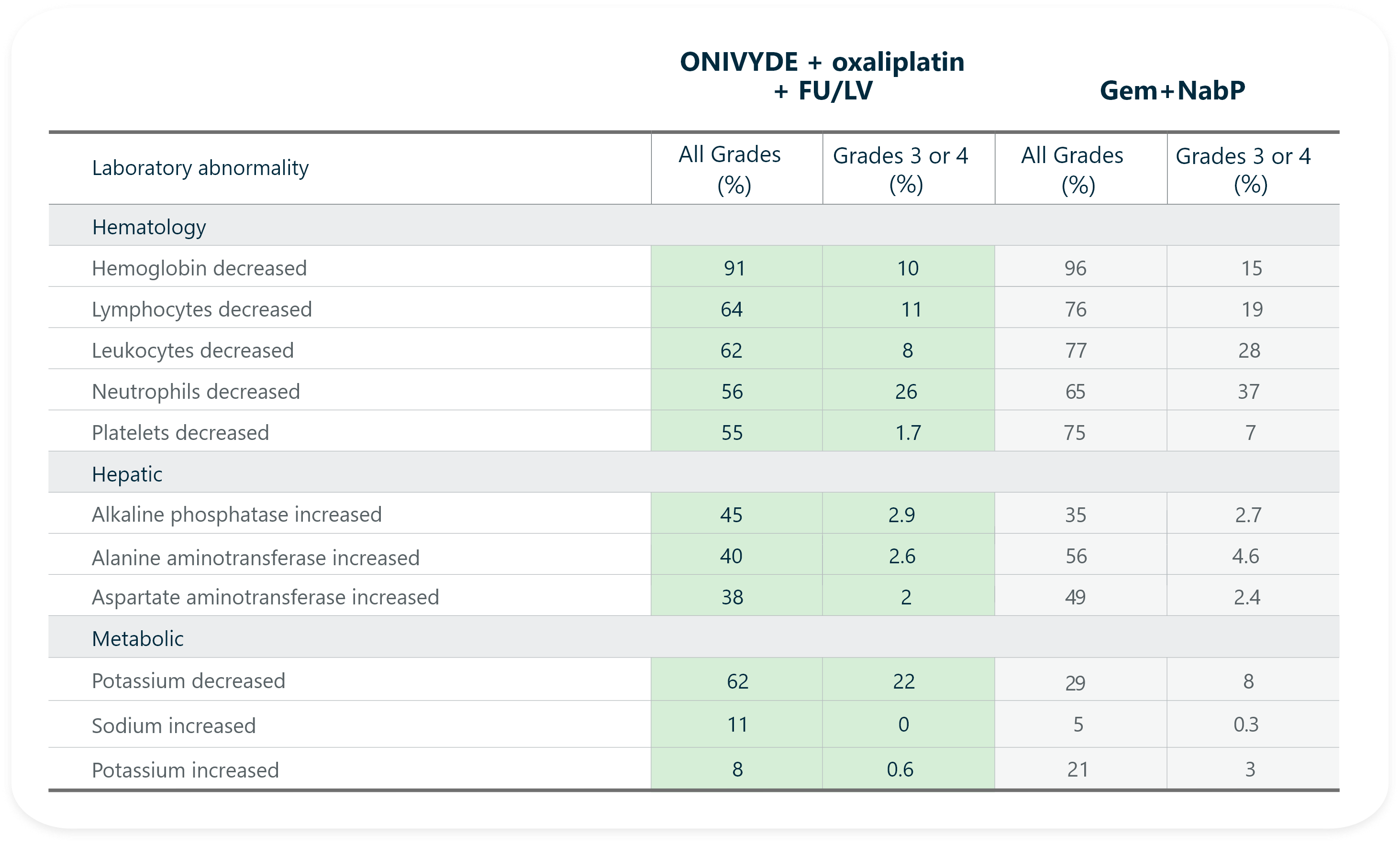
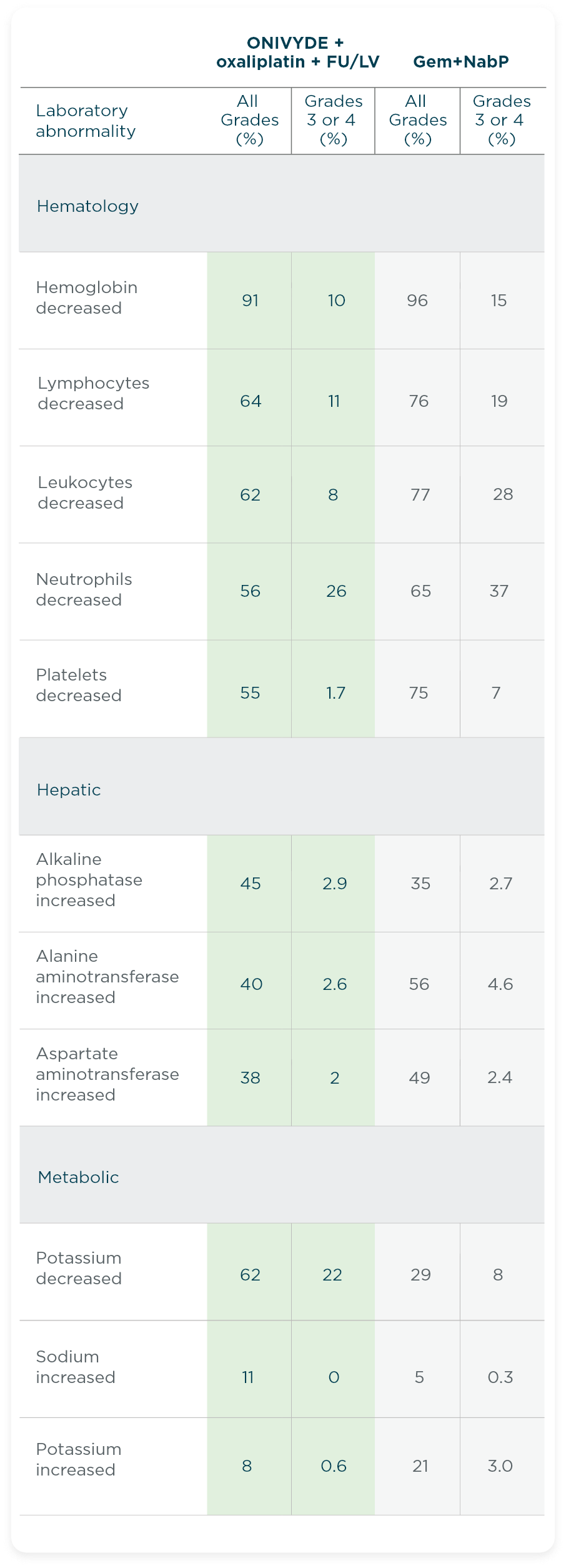
Laboratory abnormalities in patients with mPDAC who received NALIRIFOX with a difference between arms of ≥5% for all vs Gem+NabP in NAPOLI 31‡
Discontinuation rate due to adverse events was 17%1
- The incidence of all grade and severe neutrophils decreased, platelets decreased, lymphocytes decreased, leukocytes decreased, and hemoglobin decreased were lower in the NALIRIFOX treatment arm
Median duration of treatment2
- ONIVYDE (as part of the NALIRIFOX regimen): 24.3 weeks
- Gem+NabP: 17.6 weeks
*NCI CTCAE v5.0.1
†Includes multiple related terms.
‡Each test incidence is based on the number of patients who had both baseline and at least one on-study laboratory measurement available: NALIRIFOX (range: 294 to 351 patients) and Gem+NabP (range: 303 to 373 patients).1
AEs=adverse events; NCI CTCAE=National Cancer Institute Common Terminology Criteria for Adverse Events.

ADDITIONAL SAFETY DATA BY UGT1A1*28 STATUS IN NAPOLI 321
UGT1A1 encodes for an enzyme critical for metabolizing irinotecan. Variations in the UGT1A1 gene, specifically the *28 allele, may influence how patients process and tolerate irinotecan.22 A preplanned exploratory analysis from NAPOLI 3 evaluated the impact of UGT1A1*28 status on treatment tolerability in patients receiving NALIRIFOX.21
Post hoc analysis exploratory endpoint: Safety by UGT1A1*28 status21*
UGT1A1*28 status was evaluated to understand whether genotype influenced tolerability in NAPOLI 3
- UGT1A1*28 status was determined for all patients prior to enrollment
- Regardless of genotype, all patients received the full starting dose of ONIVYDE (50 mg/m2) and followed the same dose reduction guidance
- In NAPOLI 3, 83 patients (~11%) were homozygous for UGT1A1*28 (NALIRIFOX, n=39/83; Gem+NabP, n=44/83)
*Homozygous [TA77] or nonhomozygous [other genotypes].
Study limitations: Analyses were descriptive in nature. The conclusions are limited due to the small number of patients with homozygous UGT1A1*28 status (n=83).21
Safety was evaluated by UGT1A1 status to explore potential differences in tolerability between genotypes in NAPOLI 3.21
TEAEs by UGT1A1*28 status (safety population)21*
| TEAE, % (n) | UGT1A1*28 homozygous | UGT1A1*28 nonhomozygous | ||
|---|---|---|---|---|
| NALIRIFOX (n=39) |
Gem+NabP (n=44) | NALIRIFOX (n=328) | Gem+NabP (n=331) | |
| Any | 100.0% (39) | 100.0% (44) | 99.7% (327) | 99.1% (328) |
| Related to any drug | 100.0% (39) | 93.2% (41) | 94.5% (310) | 93.1% (308) |
| Grade ≥3 | 79.5% (31) | 77.3% (34) | 87.8% (288) | 87.0% (288) |
| Related to any drug | 69.2% (27) | 68.2% (30) | 70.7% (232) | 68.3% (226) |
| Serious | 61.5% (24) | 54.5% (24) | 53.7% (176) | 50.8% (168) |
| Leading to death | 5.1% (2) | 9.1% (4) | 6.1% (20) | 5.7% (19) |
*UGT1A1*28 status was unknown for three patients who received NALIRIFOX and four patients who received Gem+NabP.
| TEAE, % (n) | UGT1A1*28 homozygous | |
|---|---|---|
| NALIRIFOX (n=39) | Gem+NabP (n=44) | |
| Any | 100.0% (39) | 100.0% (44) |
| Related to any drug | 100.0% (39) | 93.2% (41) |
| Grade ≥3 | 79.5% (31) | 77.3% (34) |
| Related to any drug | 69.2% (27) | 68.2% (30) |
| Serious | 61.5% (24) | 54.5% (24) |
| Leading to death | 5.1% (2) | 9.1% (4) |
| TEAE, % (n) | UGT1A1*28 nonhomozygous | |
|---|---|---|
| NALIRIFOX (n=328) | Gem+NabP (n=331) | |
| Any | 99.7% (327) | 99.1% (328) |
| Related to any drug | 94.5% (310) | 93.1% (308) |
| Grade ≥3 | 87.8% (288) | 87.0% (288) |
| Related to any drug | 70.7% (232) | 68.3% (226) |
| Serious | 53.7% (176) | 50.8% (168) |
| Leading to death | 6.1% (20) | 5.7% (19) |
*UGT1A1*28 status was unknown for three patients who received NALIRIFOX and four patients who received Gem+NabP.
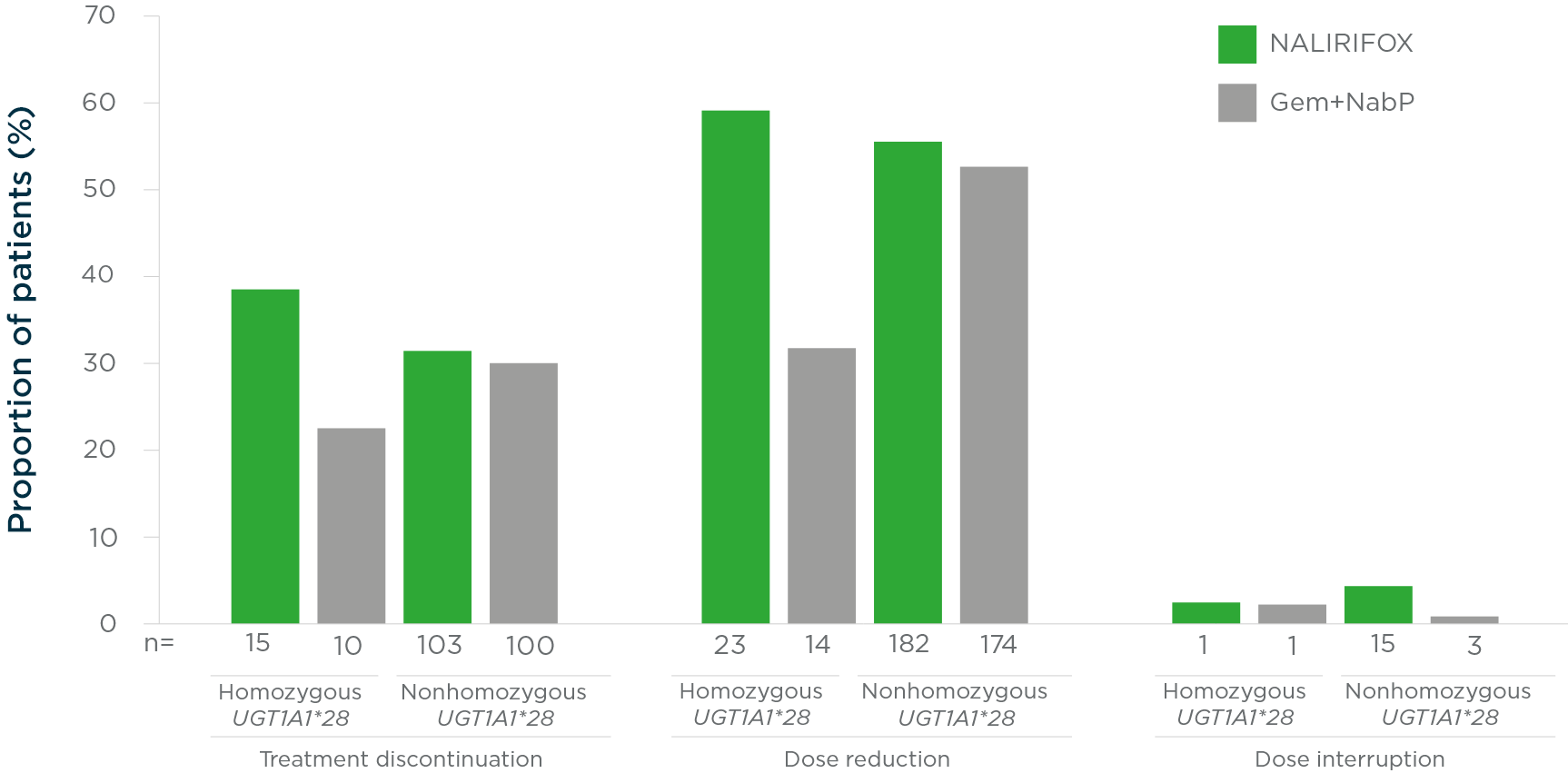
Study limitations: This post hoc analysis was exploratory and descriptive in nature. This study describes the impact of UGT1A1*28 status on the management of all components of NALIRIFOX. Per the ONIVYDE USPI, in NAPOLI 3 patients homozygous (N=39) and nonhomozygous (N=328) for the UGT1A1*28 allele initiated ONIVYDE at the same starting dose of 50 mg/m². Grade 3 or 4 neutropenia occurred in 23% vs 13% of homozygous and nonhomozygous patients, and dose reductions of ONIVYDE due to TEAEs occurred in 59% vs 51%.21
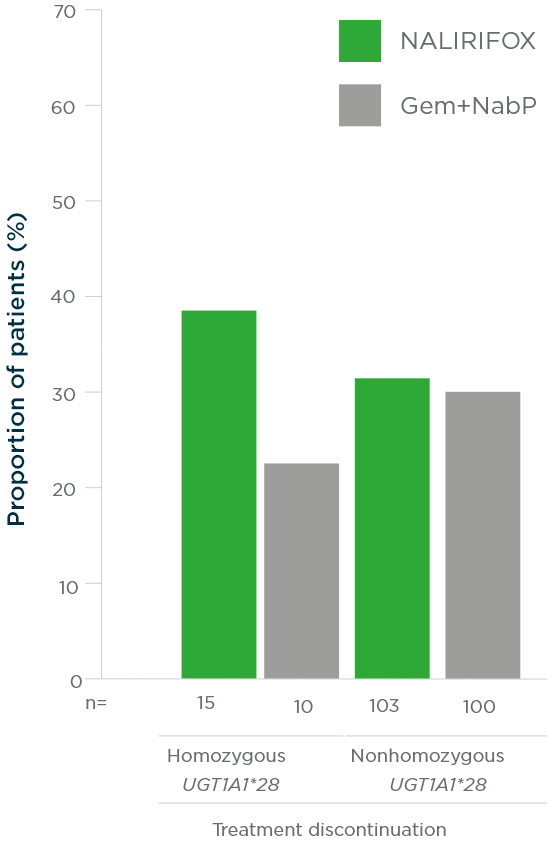
TEAEs leading to treatment discontinuation, dose reduction, or dose interruption† by UGT1A1*28 allele status21‡
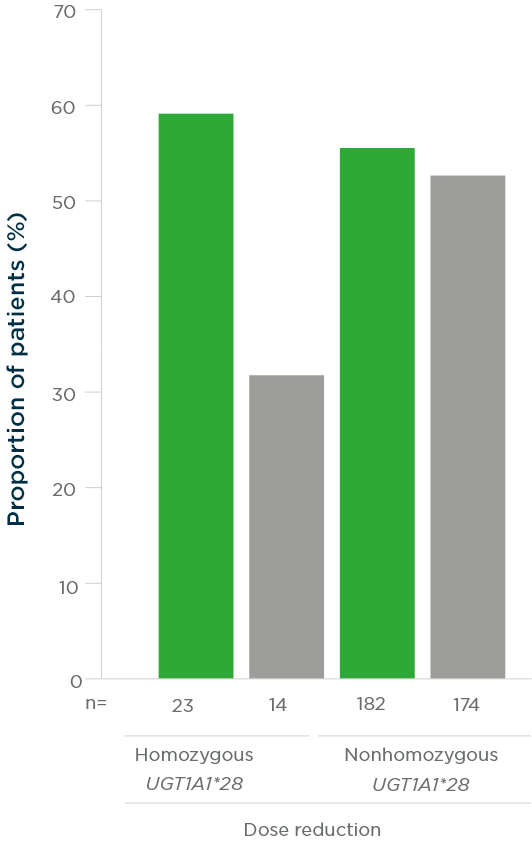
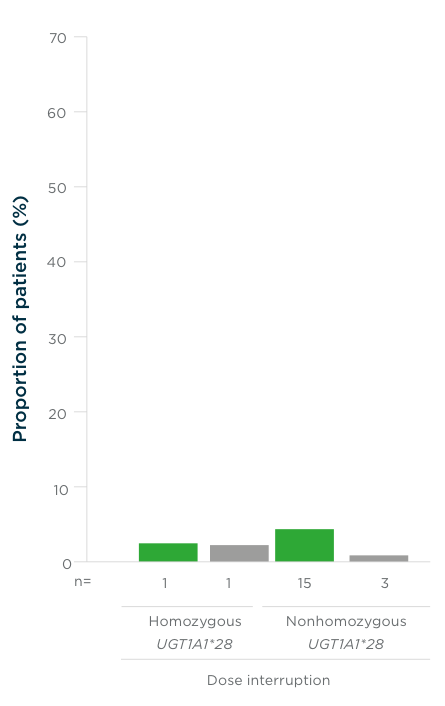
†Reflects modifications to any component of the NALIRIFOX regimen.
‡The homozygous group includes 39 patients who received NALIRIFOX and 44 patients who received Gem+NabP.
The nonhomozygous group includes 328 patients who received NALIRIFOX and 331 patients who received Gem+NabP.
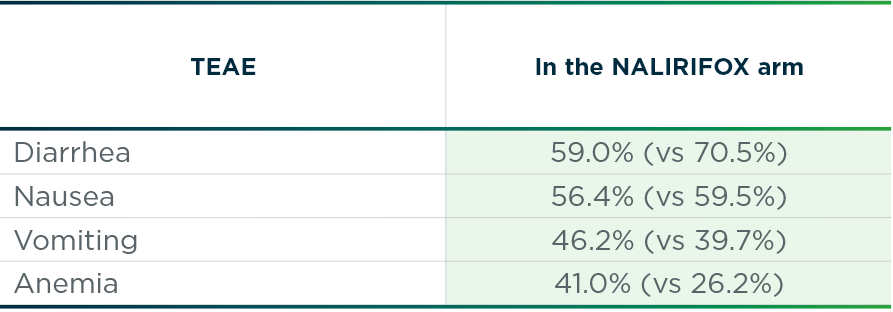
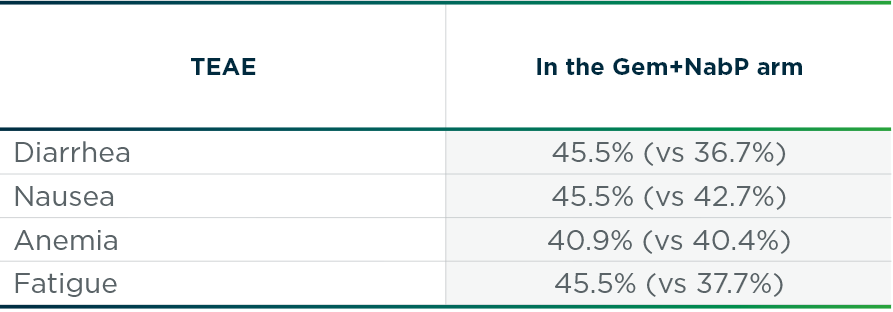
Most frequently reported TEAEs (≥40%) in homozygous group vs the overall NAPOLI 3 population21:
| TEAE | In the NALIRIFOX arm |
|---|---|
| Diarrhea | 59.0% (vs 70.5%) |
| Nausea | 56.4% (vs 59.5%) |
| Vomiting | 46.2% (vs 39.7%) |
| Anemia | 41.0% (vs 26.2%) |
| TEAE | In the Gem+NabP arm |
|---|---|
| Diarrhea | 45.5% (vs 36.7%) |
| Nausea | 45.5% (vs 42.7%) |
| Anemia | 40.9% (vs 40.4%) |
| Fatigue | 45.5% (vs 37.7%) |
USPI=United States Prescribing Information.